





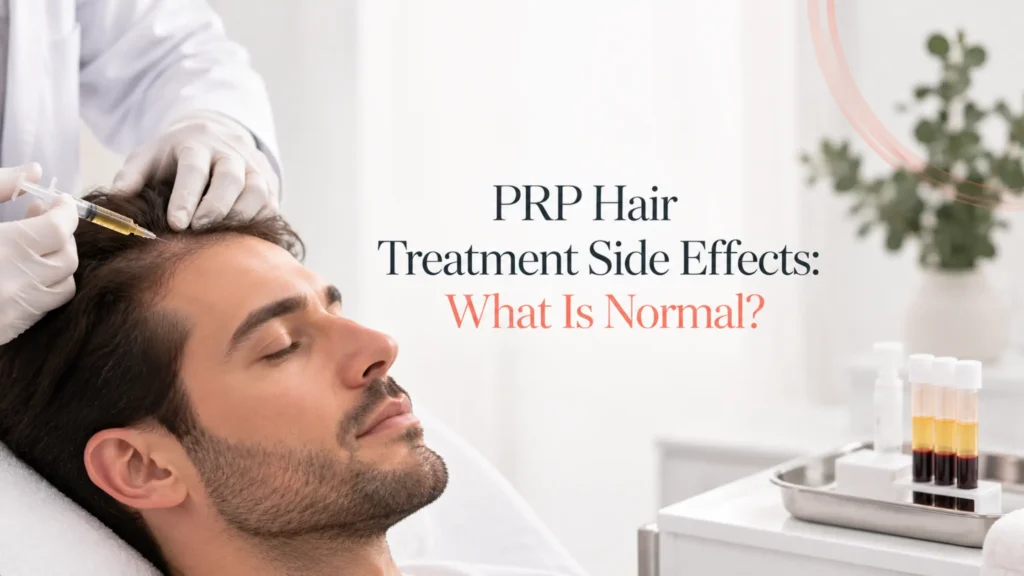
PRP hair treatment is remarkably safe with minimal side effects compared to surgical alternatives. Most patients experience only minor, temporary reactions that resolve within days.
Understanding what’s normal helps you prepare for treatment and appreciate why PRP remains the preferred choice for many seeking hair restoration without surgical intervention.
Why PRP Is Safer Than Surgical Alternatives
The Non-Invasive Advantage
PRP involves injecting your own plasma directly into the scalp through a fine needle. Unlike FUE (Follicular Unit Extraction) or other hair transplant methods, there’s no surgical incision, tissue removal, or extensive wound creation.
This fundamental difference translates to dramatically fewer complications and recovery requirements.
Comparing Safety Profiles
FUE hair transplants involve extracting hundreds or thousands of individual follicles, creating small wounds in both donor and recipient areas. These surgical procedures carry documented risks including infection, scarring, and prolonged recovery. PRP’s injection-based approach avoids these complications entirely.
Why Doctors Prefer PRP
Most clinicians increasingly favour PRP for initial hair loss treatment because it offers significant benefits with minimal downside. Patients can resume normal activities immediately. No visible scars develop, no extended recovery time, and side effects rarely exceed mild scalp tenderness.
When comparing treatment options, PRP’s profile stands out distinctly.
Common PRP Side Effects
Temporary Scalp Discomfort
Most patients experience mild scalp tenderness for 24 to 48 hours post-treatment. This feels like minor soreness after an injection, not significant pain. Over-the-counter paracetamol or ibuprofen effectively manages any discomfort, though many patients need nothing.
Mild Swelling
Localized scalp swelling occurs in approximately 20 to 30 percent of patients. Swelling typically appears within hours and resolves within 2 to 3 days. Normal healing processes cause this minor puffiness as the body responds to treatment.
Temporary Redness
Some patients notice mild redness at injection sites lasting 24 to 48 hours. This resembles minor sunburn and causes no discomfort. Redness resolves completely without intervention or special care.
Slight Itching
Occasional itching at treatment sites occurs in roughly 15 to 20 percent of patients. This typically lasts days, not weeks. Resist scratching despite the urge, as this prevents irritation.
Minimal Bruising
Minor bruising occasionally appears around injection sites. Bruising is extremely light and barely visible in most cases. Any bruising resolves within one week, often faster.
What You Won’t Experience With PRP
No Surgical Scarring
Unlike FUE which leaves numerous small scars in donor areas, PRP creates no permanent marks. The scalp remains completely unmarked and unchanged externally. This distinction matters significantly for patients concerned about visible treatment evidence.
No Extensive Recovery Time
Surgical hair transplants typically require 7 to 14 days recovery before normal activities resume. With PRP, you return to work immediately without restrictions. Most patients treat PRP on Friday and work normally Monday.
No Infection Risk
Serious infections from PRP are extraordinarily rare when performed in clinical settings with proper sterile technique. Surgical procedures carry documented infection rates requiring antibiotic treatment.
No Numbness or Nerve Damage
FUE and transplants sometimes cause temporary or permanent scalp numbness through nerve injury. PRP involves no tissue removal, eliminating this risk entirely.
Rare Side Effects
Temporary Hair Shedding
Approximately 30 to 40 percent of patients experience increased shedding within weeks of treatment. This represents normal healing, not treatment failure. Existing weak hairs shed while new, stronger hairs develop. Shedding resolves within 8 to 10 weeks.
Mild Headaches
Some patients report mild headaches within 24 hours of treatment. These are uncommon and brief, resolving with basic pain relief. Headaches don’t indicate complications or treatment problems.
Allergic Reactions
True allergic reactions to PRP are exceptionally rare since the treatment uses your own blood. No foreign substances trigger allergies. Extremely sensitive individuals might react to local anaesthetic used during treatment.
PRP vs Surgical Methods: Side Effect Comparison Table
| Side Effect | PRP | FUE Hair Transplant |
| Pain during procedure | Minimal (topical anaesthetic) | Moderate to significant |
| Post-procedure discomfort | 1-2 days | 7-14 days |
| Scalp scarring | None | Multiple small permanent scars |
| Visible marks | None | Visible for weeks |
| Recovery time | Immediate | 1-2 weeks minimum |
| Infection risk | Extremely low | Low but documented |
| Numbness risk | None | Possible, sometimes permanent |
| Cost | Lower | Very high |
| Work restriction | None | 7-14 days |
| Results timeline | 3-6 months | 6-12 months |
Safety Measures Preventing Complications
Professional Environment
Treatment in CQC-registered clinics with trained professionals ensures sterile technique and proper protocol adherence. Professional settings dramatically reduce infection and complication risks.
Proper Patient Screening
Comprehensive medical history and blood work identify contraindications before treatment. Understanding your individual circumstances helps determine if PRP suits your needs. Patients with certain conditions may require special consideration or postponement.
Correct Injection Technique
Experienced practitioners inject precisely into correct scalp depths and locations. Proper technique prevents nerve injury and maximises efficacy while minimising discomfort.
Normal Post-Treatment Expectations
First 24 Hours
Expect mild scalp tenderness and possible swelling. Avoid strenuous activity, hot showers, and direct sun exposure for the first day. Continue normal daily activities without restrictions.
Days 2 to 7
Swelling and redness should resolve. Mild itching or tenderness may persist but decreases daily. Normal shampooing resumes after 48 hours with gentle technique.
Weeks 2 to 6
Increased shedding typically peaks during this period. Hair loss can seem dramatic, but this represents normal healing and regrowth preparation. This temporary increase is actually a positive sign of active treatment response. No intervention needed, as shedding resolves spontaneously.
Months 1 to 6
New hair growth gradually becomes visible. Results improve progressively over several months. Patience during this period yields the best outcomes.
When to Contact Your Clinic
Seek professional evaluation if you experience:
- Severe pain not relieved by standard pain relief medication
- Fever or signs of infection (spreading redness, pus, warmth)
- Allergic reactions (facial swelling, difficulty breathing)
- Persistent symptoms beyond normal timeframes
- Concerning scalp changes unrelated to normal healing
Most patients never need post-treatment contact beyond standard follow-up appointments.
Conclusion
PRP hair treatment side effects are genuinely minor and temporary, representing the price of remarkably safe and effective hair restoration. Comparing PRP’s modest discomfort to FUE’s surgical wounds, extended recovery, and permanent scarring clarifies why clinicians and patients increasingly favour PRP. When understanding both the benefits and side effects, PRP emerges as the clearly superior first-line treatment for hair loss, delivering meaningful results with negligible downside.
Frequently Asked Questions
Are PRP side effects worse than doing nothing about hair loss?
Absolutely not. PRP causes only minor, temporary effects. Untreated hair loss progresses steadily, causing psychological distress and permanent follicle damage. PRP’s minimal side effects pose negligible risk compared to hair loss consequences.
How do PRP side effects compare to minoxidil or finasteride?
Oral finasteride carries systemic side effects including sexual dysfunction in some users. Minoxidil causes scalp irritation in many patients. PRP produces only local, temporary effects without systemic impact or chronic complications.
Will side effects prevent me from working or exercising?
No. You can return to work immediately after treatment. Light to moderate exercise resumes the next day. Avoid only intense sweating during the first 48 hours to prevent irritation.
Do side effects indicate the treatment failed?
No. Side effects represent the body’s normal healing response, not treatment failure indicators. Patients experiencing no side effects respond equally well as those with minor temporary reactions.
Can I prevent PRP side effects?
You can minimise them through proper post-treatment care: avoiding extreme temperatures, excessive sweating, and direct sun exposure for 48 hours. Most side effects are unavoidable but harmless aspects of the healing process.
Is PRP safer for people with sensitive scalps?
Yes. Since PRP uses your own blood, allergic reactions are virtually impossible. Professional technique accommodates scalp sensitivity effectively. Topical or local anaesthetic options exist for particularly sensitive individuals.
Why does hair shed after PRP if the treatment works?
Shedding represents the treatment working correctly. PRP stimulates weak, dying hairs to shed while triggering new, stronger hairs to develop. This temporary shedding phase indicates successful biological response.
Selected References
- Tessler R, et al. (2018). Platelet-Rich Plasma as a Treatment for Hair Loss: Review of Clinical Evidence and Mechanism of Action. Journal of Cosmetic Dermatology, 17(6), 930-941.
- Singhal P, Agarwal S, et al. (2015). Efficacy of Platelet-Rich Plasma in Hair Restoration: A Randomized Controlled Trial. Dermatologic Surgery, 41(10), 1141-1146.
- Strauss EJ, Hart JA, et al. (2016). Platelet-Rich Plasma Enhances Tendon-to-Bone Healing in Anterior Cruciate Ligament Reconstruction. The American Journal of Sports Medicine, 44(12), 3077-3085.
- Cole R, et al. (2017). Dermatologic Complications of Cosmetic Procedures: Prevention and Management. Journal of the American Academy of Dermatology, 71(4), 558.e1-558.e12.
- Gkini GA, et al. (2014). Study of Platelet-Rich Plasma Preparation and Stimulation Abilities on Hair Follicles. International Journal of Trichology, 6(2), 84-89.
- Gentile P, et al. (2017). The Effect of Platelet-Rich Plasma in Hair Regrowth: A Randomized Placebo-Controlled Trial. Journal of Cosmetic Dermatology, 16(4), 523-528.