

















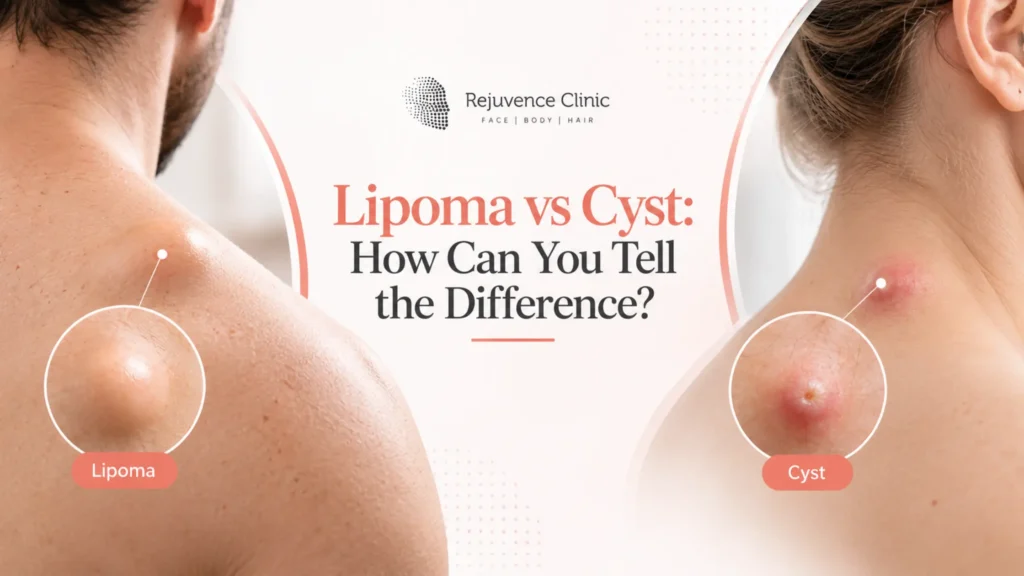
Lumps and bumps under the skin are common, but understanding what you’re dealing with is crucial for peace of mind. Lipomas and cysts often get confused, yet they’re fundamentally different conditions with distinct causes and characteristics.
Knowing how to distinguish between them helps you make informed decisions about whether treatment is needed.
What Is a Lipoma?
The Basics
A lipoma is a benign fatty tumour that grows slowly beneath the skin. It’s completely harmless in the vast majority of cases. Lipomas are common soft, movable lumps made of normal fat cells arranged in an encapsulated mass, representing overgrowths of mature adipose tissue with no malignant potential.
Key Characteristics
Lipomas typically present with these features:
- Soft and doughy texture to the touch
- Movable and mobile under the skin surface
- Well-defined borders easily felt on examination
- Smooth, rounded appearance with normal overlying skin
- No visible opening or pore on the skin surface
They favour the shoulders, neck, back, and arms but can appear anywhere. Most grow slowly over months or years without significant change.
When Do They Appear?
Lipomas often emerge in middle age, becoming increasingly common with age. They’re more common in men than women, with genetics playing a significant role. Some people develop just one; others develop multiple lipomas throughout life.
What Is a Cyst?
Understanding Cysts
A cyst is a closed sac containing fluid, semi-solid material, or air. Sebaceous cysts are the most common skin variety, formed when oil gland ducts become blocked. They differ fundamentally from lipomas because of their contents and inflammatory potential. Epidermoid cysts can become problematic if infected.
Visual Presentation
Cysts often show distinctive features:
- Visible central pore or dot on the skin surface
- Firmer, more defined boundaries than lipomas
- May appear flesh-coloured or yellowish
- Possible scaling around the opening
- Location often on face, scalp, or trunk
Development and Progression
Cysts can appear suddenly or develop gradually. They may stay stable for years or occasionally leak yellowish discharge. Infection causes swelling, redness, and tenderness requiring urgent evaluation.
Comparison Table: Lipoma vs Cyst at a Glance
| Feature | Lipoma | Cyst |
| Composition | Normal fat cells | Keratin and sebum |
| Texture | Soft, doughy | Firmer, defined |
| Surface Feature | Smooth, no pore | Visible central pore |
| Mobility | Easily movable | More fixed |
| Growth Rate | Very slow (years) | Can appear suddenly |
| Common Locations | Shoulders, back, neck | Face, scalp, trunk |
| Symptoms | Usually none | Can be painful if infected |
| Treatment Needed | Only if cosmetic concern | Often recommended |
| Recurrence | Rare (<5%) | Moderate (20-40%) |
| Cancer Risk | None | None |
How to Tell Them Apart: Key Differences
Texture and Feel
Lipomas feel uniformly soft and squishy, compressing easily under gentle pressure. Cysts feel firmer and more defined with a clearer, harder boundary. This tactile difference is often the first and most reliable clue during examination.
Appearance and Surface
Lipomas appear as smooth, rounded bumps under normal skin with no visible opening. Cysts often show a central pore or dot, sometimes visible to the naked eye. This opening represents the blocked duct and is rarely seen with lipomas.
Growth Rate
Lipomas grow very slowly over years, with many remaining unchanged for decades. Cysts can appear or enlarge suddenly, sometimes over weeks. Rapid changes suggest a cyst rather than a lipoma, especially if accompanied by inflammation.
Location Patterns
Lipomas favour areas with significant subcutaneous fat:
- Shoulders and upper back
- Neck and nape
- Upper arms and forearms
- Thighs and buttocks
Cysts prefer areas prone to friction or sun exposure:
- Face and forehead
- Scalp and ears
- Neck and chest
- Back and trunk
Mobility
Lipomas are easily movable when gentle pressure is applied; the skin slides freely over them. Cysts often feel more fixed or embedded. This difference helps distinguish them during examination.
Understanding Symptoms
Lipoma Symptoms
Most lipomas cause absolutely no symptoms. They exist as painless lumps beneath normal skin. Rarely, pressure on nearby nerves causes mild discomfort. Common presentations include:
- No pain or tenderness
- Only cosmetic concern about appearance
- Occasional pressure if in high-friction areas
- Stable, unchanging over time
Cyst Symptoms
Cysts can present with various symptoms:
- Asymptomatic initially in many cases
- Tender or painful when inflamed or infected
- Discharge or odour if they rupture
- Swelling and redness from secondary infection
- Itching or irritation in some situations
These symptoms warrant professional evaluation to rule out infection and determine appropriate management.
When Should You Seek Professional Help?
Red Flags Requiring Evaluation
Certain warning signs necessitate professional assessment:
- Rapid growth developing over weeks
- Inflammation, discharge, or pain suggesting infection
- Bleeding or severe discomfort affecting daily life
- Cosmetic concerns causing psychological distress
- Uncertainty about diagnosis preventing peace of mind
Any lump causing concern deserves expert evaluation to ensure proper diagnosis and appropriate management.
Treatment Options
Lipoma Treatment
Most lipomas don’t need treatment and remain stable indefinitely. Surgical removal under local anaesthetic is straightforward with minimal scarring. Removal is appropriate if causing cosmetic concern, physical discomfort, or nerve pressure. Recurrence is rare after complete excision.
Cyst Treatment
Small, asymptomatic cysts often need no treatment. Regular monitoring ensures stability. Infected cysts may require drainage for relief, though recurrence is common without complete removal. Cryotherapy or surgical excision provides more durable results. Professional assessment determines the best approach for your situation.
Evidence-Based Understanding
What Research Shows
Studies confirm that lipomas are benign fatty proliferations that never transform into harmful conditions. Clinical evidence demonstrates that conservative management suits most patients. Surgical outcomes are excellent when intervention is needed.
Professional Guidelines
NHS guidance recommends professional evaluation for changing lumps or concerning features. Monitoring stable lesions is safe and appropriate with no health risks. Treatment decisions should reflect individual symptoms and preferences.
The Rejuvence Approach
Our Assessment Process
We begin with thorough examination and detailed history. Advanced imaging clarifies diagnosis when needed. Professional guidance helps you make informed decisions about your care.
Tailored Treatment Plans
Each patient’s needs differ based on location, size, and personal priorities. We discuss all options comprehensively. Your comfort and confidence guide our recommendations throughout.
Conclusion
Lipomas and cysts are common, benign skin lesions with distinct characteristics helping differentiate them clearly. Understanding the differences between these conditions empowers you to make informed decisions about your health. If you notice any concerning lumps, rapid changes, or symptoms affecting your quality of life, seek professional assessment to confirm diagnosis and discuss appropriate management options tailored to your individual needs.
Frequently Asked Questions
Can a lipoma turn into cancer?
No, lipomas are benign and cannot transform into cancer. However, rapidly growing lumps warrant professional evaluation to confirm diagnosis.
How do I know if a cyst is infected?
Infected cysts show redness, warmth, swelling, and tenderness. Pus or foul-smelling discharge indicates infection requiring prompt professional assessment.
Can I remove a lipoma or cyst at home?
No, attempting home removal risks serious infection, permanent scarring, and incomplete removal. Professional treatment ensures safe, effective outcomes.
How long does removal take?
Lipoma removal typically takes 20-30 minutes under local anaesthetic. Cyst removal is similarly quick. Most patients return to normal activities within days.
Will a lipoma or cyst come back after removal?
Properly excised lipomas rarely recur (less than 5%). Cysts recur at higher rates (20-40%) if only drained rather than completely removed.
Which is more common, lipomas or cysts?
Both are extremely common benign lesions. Millions develop these annually. Most never cause problems or require treatment.
What’s recovery like after removal?
Recovery is typically straightforward with minimal pain or downtime. Most patients manage with over-the-counter pain relief and resume normal activities within one week.
What should I do if I find a new lump?
Schedule a professional evaluation to confirm diagnosis. Most lumps are benign, but professional assessment provides peace of mind and guides appropriate management.
Selected References
- Gaskins ME, et al. (2009). Lipomas: Diagnosis and treatment. American Family Physician, 80(12), 1405-1410.
- Zuber TJ. (2002). Minimal excision technique for epidermoid (sebaceous) cysts. American Family Physician, 65(8), 1409-1414.
- Mandeville H, Magill L. (2021). Benign skin lesions in primary care. British Journal of General Practice, 71(704), 108-109.
- Rapini RP, Lipman MD. (2009). The recognition of sebaceous cyst equivalents and other epidermoid and trichilemmal cyst mimickers. The Journal of Clinical and Aesthetic Dermatology, 2(7), 44-48.
- Mackie RM. (2019). Diagnostic and management approach to pigmented lesions. British Medical Journal, 325(7365), 613-617.
- Kwartler AJ, et al. (2012). Common benign skin tumors. American Family Physician, 85(2), 149-155.