















A Clinical Perspective from Rejuvence Clinic
Alopecia areata is one of the more distressing conditions we treat, and one of the most misunderstood. Unlike pattern hair loss, which develops gradually over years, alopecia areata can appear suddenly: a smooth, round patch of complete hair loss that seems to come from nowhere. For many patients the psychological impact is significant, and the unpredictability of the condition only adds to the worry.
For a long time, the standard response was a steroid injection into the affected patch. It often worked, and it remains a core part of how we treat the condition. But like many older single-treatment approaches, it has limitations, and it was never the whole answer.
The addition of Exciplex excimer light therapy has given us a second, complementary tool, and combining the two has become one of our most effective strategies.
This article explains what alopecia areata actually is, what the steroid injection does and where it falls short, how Exciplex works, and why we increasingly recommend using both together.
What Alopecia Areata Actually Is
The Immune Attack
The first thing to understand is that alopecia areata is not the same as ordinary hair loss. It is an autoimmune condition.
In alopecia areata, the immune system, which is meant to defend the body against infection, mistakenly identifies the hair follicles as a threat and attacks them. Specifically, immune cells (T lymphocytes) cluster around the actively growing follicle and disrupt its normal cycle.
On examination, this is sometimes described as resembling a swarm of bees around the follicle. The result is that the hair is pushed out and new growth is suppressed, producing the characteristic smooth, well-defined patches of loss.
Key Characteristics
Several features make the condition particularly challenging:
It is unpredictable. Hair may regrow spontaneously in one area while new patches appear elsewhere.
It varies enormously in severity. Some people experience a single small patch that recovers; others develop extensive loss across the scalp (alopecia totalis) or the whole body (alopecia universalis).
It can relapse. Even after successful regrowth, the condition can return at a later date.
The follicles usually survive. Importantly, in alopecia areata the follicles are typically not destroyed but switched off. This is the reason regrowth is genuinely possible, and why treatment is worthwhile.
Why Treatment Matters
Because the root of the problem is an immune attack, effective treatment is about calming or redirecting that immune response in the affected area, giving the follicles the opportunity to recover.
The Steroid Injection: A Proven First Step With Real Limits
How Steroids Work
Intralesional corticosteroid injection (usually triamcinolone) has been a mainstay of alopecia areata treatment for decades, and with good reason. Steroid treatment for alopecia areata delivers an anti-inflammatory, immune-calming medication directly into the affected patch, suppressing the local immune attack and allowing the follicles to re-enter their growth phase. For localised, limited disease, response rates are good, and it is often the first thing we reach for.
Significant Limitations
But it is not suitable for every patient or every situation, and the limitations are worth understanding:
It is impractical for large areas. Injecting a small patch is straightforward. Treating extensive loss across much of the scalp with injections is not realistic.
It can be uncomfortable. The treatment involves multiple injections into the scalp, which not everyone tolerates well, and which can be a particular barrier for younger patients.
It carries a risk of skin thinning. Repeated injections in the same area can cause localised atrophy, a small depression in the skin, if not carefully managed.
It does not prevent new patches. Like the steroid injection in acne, it treats the area in front of you. It does not stop the condition appearing elsewhere.
Why Combined Approaches Matter
So while the steroid injection is effective and well established, relying on it alone leaves gaps, particularly for patients with more widespread disease, those who find injections difficult, and those whose condition keeps moving to new areas.
How Exciplex Excimer Light Works
The 308nm Wavelength Technology
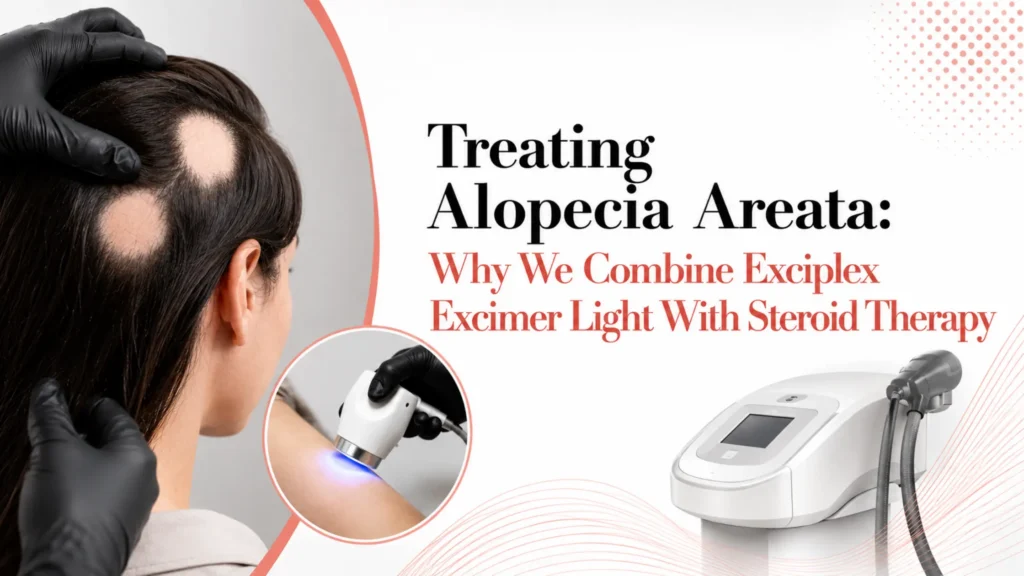
Exciplex is a targeted light therapy that delivers monochromatic light at a wavelength of 308nm, produced by an excimer source. This is not a heat-based or ablative laser. Exciplex excimer treatment works through the immune system, which is exactly what alopecia areata calls for.
The 308nm wavelength has a specific, well-documented effect on the immune cells driving the condition. Delivered to the affected skin, it induces apoptosis (programmed cell death) in the T lymphocytes that are attacking the follicles, and it alters the local production of inflammatory signalling molecules.
In practical terms, it calms the autoimmune attack precisely where it is happening, without the need for injections and without affecting the rest of the body.
Key Advantages
This gives Exciplex several attractive qualities:
It is non-invasive. Treatment is delivered as light to the surface of the skin, so there are no injections.
It is targeted. The 308nm wavelength acts on the immune activity in the treated area specifically.
It is well tolerated. Side effects are generally mild and confined to the treated area, most commonly temporary redness. This compares favourably with the discomfort and atrophy risk of repeated injections.
It can cover areas where injection is impractical. The device can treat larger or awkwardly placed patches, and adapt to smaller lesions as needed.
The same 308nm excimer technology has a well-established track record in other immune-mediated skin conditions, including vitiligo and psoriasis, which adds to the confidence behind its use.
What the Evidence Shows, Honestly
Research Findings
We always try to be candid about the evidence rather than overstating it, and alopecia areata is an area where honesty matters because patients are often anxious and vulnerable to overpromising.
The clinical research on 308nm excimer therapy for alopecia areata is encouraging. Studies, including randomised controlled trials and meta-analyses, show that it produces meaningful hair regrowth in a significant proportion of patients with localised disease. When excimer therapy has been compared directly with intralesional steroid injection, the picture is informative:
Both treatments produce regrowth in many patients with localised alopecia areata.
Intralesional steroid injection has sometimes shown a slight edge in the speed or degree of regrowth in direct comparisons, though the difference often narrows over the following weeks.
Excimer light is consistently associated with fewer and less severe side effects than repeated steroid injections.
Combination approaches, using light therapy alongside steroid (topical or injected), are reported to be effective and are increasingly favoured.
The Clinical Conclusion
The reasonable conclusion is not that one treatment is universally superior, but that they are complementary. Each has strengths the other lacks, which is precisely why combining them makes clinical sense.
Why We Combine the Two
Complementary Strengths
Putting this together, our preferred strategy for many patients is to use steroid therapy and Exciplex excimer light together rather than choosing between them.
The steroid component delivers a strong, direct immune-calming effect to the most affected patches.
The Exciplex component extends targeted, well-tolerated treatment across the affected areas, including those where repeated injection would be impractical or poorly tolerated, and adds a second mechanism of action working towards the same goal.
Optimising Outcomes
The aim is to suppress the autoimmune attack more completely and more comfortably than either approach manages alone, giving the follicles the best possible opportunity to recover. In our experience, combination treatment offers more consistent results, particularly for patients whose condition is more than a single small patch.
Being Honest About Expectations
The Reality of Alopecia Areata
Alopecia areata is a condition that demands realism, and we would rather set expectations carefully than disappoint.
It is unpredictable by nature. Even with effective treatment, the course of the condition can vary, and relapse is possible.
Response takes time. Hair regrowth is a slow biological process. A course of treatment over weeks to months is needed, and patience is essential.
Extensive disease is harder to treat. Very widespread alopecia (totalis or universalis) responds less reliably to localised treatments, and may call for a different, specialist-led approach.
Advanced Options for Severe Cases
Newer systemic options exist for severe cases. For severe, treatment-resistant alopecia areata, newer oral medications (JAK inhibitors) have changed what is possible, but these are systemic, prescription-only treatments with their own considerations, appropriate for a specific subset of patients. We will always tell you honestly if your condition might be better served by that route.
Our Honest Position
The honest position is that localised alopecia areata often responds well to the combination we have described, that the follicles are usually intact and capable of regrowth, and that a well-planned, doctor-led approach gives the best chance of a good outcome, without anyone pretending the condition is fully predictable.
The Rejuvence Approach
Our alopecia areata care is doctor-led and delivered in a CQC registered clinic, and it begins with a proper assessment rather than a standard formula. We look at the pattern and extent of loss, how it is behaving, your medical history, and what you want to achieve. Book a consultation for alopecia areata treatment to discuss your options.
From there, treatment may combine:
Intralesional or topical steroid to calm the immune attack in the most affected areas.
A course of Exciplex excimer light therapy to extend targeted, non-invasive treatment and add a second mechanism of action.
Vitamin D assessment and optimisation, as low vitamin D is commonly associated with alopecia areata.
Where appropriate, ExoSmart exosome therapy as a regenerative adjunct to support the follicular environment.
We will also be straightforward with you about when a condition is best managed conservatively, when combination therapy is the right move, and when a referral or a systemic, specialist-led approach would serve you better.
If you are dealing with alopecia areata and would like an honest assessment and a treatment plan built around your particular situation, our team would be glad to help. We offer a consultation where we can examine your scalp properly and talk you through the most appropriate options.
Disclaimer: This article is intended for general information and education. It does not constitute medical advice, and it is not a substitute for a personalised consultation. Treatment suitability, benefits and risks vary between individuals and should be discussed with a qualified clinician. Individual results cannot be guaranteed.
Selected References
- Kianfar N, et al. (2022). Comparison of the efficacy and safety of 308-nm excimer laser with intralesional corticosteroids for the treatment of alopecia areata: A randomized controlled study. Lasers in Surgery and Medicine, 54(6).
- Meta-analysis of 308-nm excimer laser therapy for alopecia areata. (2020). Journal of the American Academy of Dermatology.
- 308 nm-Excimer light together with topical betamethasone valerate in treating alopecia areata. (2025). Archives of Dermatological Research.
- Comparison of efficacy of intralesional triamcinolone versus 308nm excimer laser in localized alopecia areata. Journal of Pakistan Association of Dermatologists.
- Al-Mutairi N. (2007). 308-nm excimer laser for the treatment of alopecia areata. Dermatologic Surgery.
- Mehraban S, Feily A. (2014). 308nm excimer laser in dermatology. Journal of Lasers in Medical Sciences, 5(1).
- The role of excimer light in dermatology: a review. (2024). Clinical, Cosmetic and Investigational Dermatology.